

 USA
USA
 Canada
 Australia

Introduction
Bookkeeping software has become the preferred choice for many Canadian businesses because of its affordable monthly subscription. However, as a business grows, its bookkeeping needs also increase. Features such as payroll, inventory management, receipt capture, additional users, and third-party integrations can quickly increase the overall cost, making the initial subscription only one part of the investment. Many business owners underestimate bookkeeping software subscription costs because the advertised monthly price often excludes payroll modules, additional users, and other paid features.
When comparing the cost of bookkeeping software vs outsourcing, it’s important to look beyond the advertised monthly fee. The true cost also includes the time spent managing the books, correcting errors, staff training, and maintaining compliance with GST/HST and payroll requirements. For many business owners, the true cost of DIY bookkeeping includes not only software fees but also the hours spent learning accounting processes and correcting mistakes. At NCSGX, we’ve found that evaluating the total cost of bookkeeping, not just the software subscription helps businesses choose the solution that delivers the best long-term value.
The Real Cost of Bookkeeping Software in 2026 – Subscription Creep vs Outsourced Bookkeeping
When choosing a bookkeeping solution, many Canadian business owners focus on one number, the monthly software subscription. Seeing plans advertised for less than CAD 30 per month can make bookkeeping software seem like the most affordable option. Many owners researching small business bookkeeping costs Canada focus on subscription pricing without considering payroll, compliance, and year-end support expenses.
The monthly fee for bookkeeping software is often only the starting cost. As a business grows, expenses may increase through payroll modules, inventory tools, receipt capture, payment processing, third-party integrations, and higher-tier subscription plans. Business owners also spend time learning the software, fixing bookkeeping issues, and preparing records for year-end.
This is why the cost of bookkeeping software vs outsourcing is not just a comparison of subscription prices. The real consideration is the total cost of maintaining accurate books, meeting GST/HST compliance requirements, and producing reliable financial reports.
Key Takeaways
- The advertised software price isn’t the full cost. Add-ons, training, support, and implementation can significantly increase your bookkeeping expenses over time.
- Subscription creep is real. As your business grows, additional features like payroll, inventory management, and integrations can quietly raise your monthly costs.
- Consider the value of your time. Hours spent on bookkeeping, fixing errors, and preparing for year-end are part of your true bookkeeping cost.
- Outsourced bookkeeping can provide better value for growing businesses. It often includes professional expertise, accurate financial reporting, and ongoing support under a predictable monthly fee.
What “Bookkeeping Software Cost” Actually Includes in 2026
The advertised subscription price usually covers only the core bookkeeping features. As your business expands, additional tools and services often become necessary, increasing your overall monthly investment.
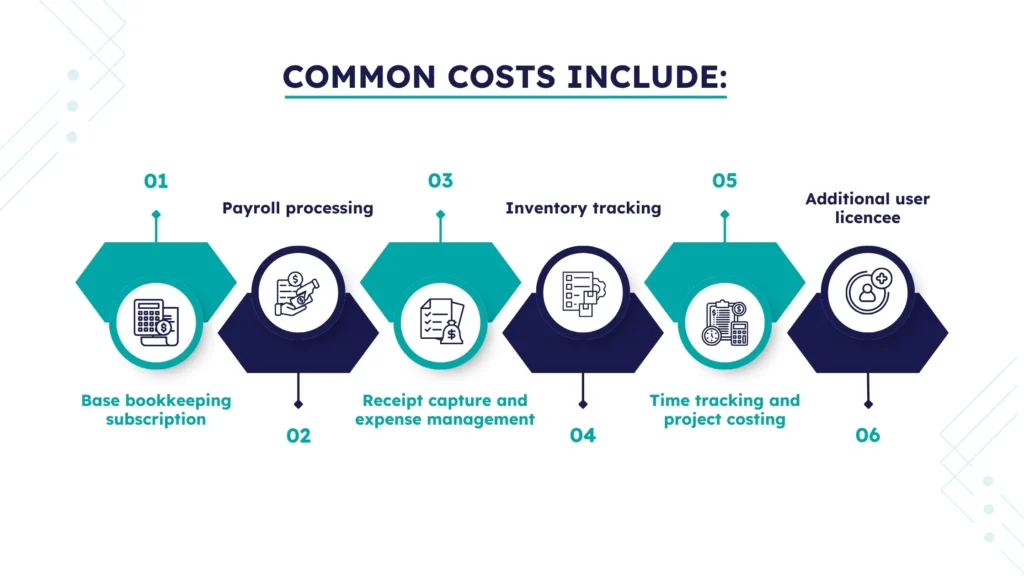
Many businesses overlook one-time expenses such as software setup, data migration, and staff training when adopting bookkeeping software. Even switching from spreadsheets may require professional help to configure accounts and verify opening balances. In addition, subscription prices can increase over time as providers update plans or move features into higher-tier packages, making the long-term cost higher than the initial monthly fee. These implementation and training expenses are examples of the hidden costs of bookkeeping software that many businesses discover only after switching systems.
How Subscription Creep Happens
Subscription creep happens when businesses gradually add paid features as their bookkeeping needs evolve. What begins as a low-cost software subscription can quickly expand with payroll, inventory management, receipt capture, payment processing, additional user licences, and third-party integrations. Individually, these upgrades may seem inexpensive, but together they can significantly increase monthly bookkeeping software costs. Reviewing your software subscriptions regularly helps ensure you’re paying only for the features that deliver real value to your business. Reviewing bookkeeping software subscription costs annually can help businesses identify unnecessary add-ons and control rising monthly expenses.
Real Monthly Cost Range for Popular Software in Canada
| Software | Reality in Canada now | Starting price (approx.) | Typical cost for a growing business | Common paid add-ons / notes |
| QuickBooks Online | Paid monthly plans; pricing depends on tier and user count. | From CAD 19/month for the discounted Simple Start offer, or CAD 38/month regular price. quickbooks.intuit | Usually CAD 38–275/month depending on tier, before add-ons. quickbooks.intuit | Payroll, extra users, advanced features, |
| Xero | Canadian pricing is in CAD and has current plan tiers. | CAD 25/month Starter, after promo period. | CAD 60–80/month for Standard and Premium. | Payroll, expense tools, project/inventory-related add-ons depending on setup. xero |
| FreshBooks | Paid monthly plans in CAD; promos may lower the first months. | Roughly CAD 26/month regular Lite price, with promo pricing sometimes lower. freshbooks | Commonly CAD 42–100+/month depending on plan and add-ons. freshbooks | Team members, advanced payments, time/project tools, add-ons. freshbooks |
| Wave | Starter/free option exists; paid plan and services are separate. | CAD 0 for Starter/free accounting. waveapps | Paid usage varies by bookkeeping, payroll, and payment services. waveapps | Payroll, online payments, bookkeeping services. waveapps |
| Zoho Books | Paid plans in CAD, with a trial available. | Usually around CAD 15/month for the entry-level plan. zoho | Commonly CAD 40–90/month depending on plan and usage. zoho | Advanced inventory, workflow automation, integrations. zoho |
For many growing companies, the decision eventually becomes QuickBooks vs outsourced bookkeeping, especially when monthly transaction volumes and payroll responsibilities increase. Although bookkeeping software remains a cost-effective solution for many businesses, the subscription fee often represents only one part of the overall investment. Once add-ons, integrations, and support services are included, the monthly cost can be considerably higher than the advertised starting price.
Hidden Costs of Bookkeeping software Most Businesses Ignore
Many of the true costs of bookkeeping software never appear on a subscription invoice. Beyond monthly fees, businesses invest time in managing transactions, reconciling accounts, training staff, correcting bookkeeping errors, handling payroll adjustments, and preparing for year-end. Mistakes such as incorrect GST/HST coding or duplicate entries can also lead to additional accountant fees and missed tax opportunities. The Canada Revenue Agency (CRA) provides useful guidance on GST/HST obligations for businesses managing their own books. When these indirect costs are considered, the true cost of DIY bookkeeping can be significantly higher than the advertised software subscription.
What Outsourced Bookkeeping Actually Costs in Canada
The cost of outsourced bookkeeping in Canada depends on factors such as transaction volume, payroll, inventory, and overall business complexity. Rather than offering a one-size-fits-all package, most providers tailor their services to each client’s needs. As a general guide, outsourced bookkeeping typically ranges from CAD 300 to CAD 1,500 or more per month, with smaller businesses usually paying less and more complex operations requiring a higher level of support. For businesses comparing alternatives, understanding outsourced bookkeeping cost Canada estimates can provide a more realistic benchmark than looking at software subscriptions alone.
Software Cost vs Outsourcing Cost, Side by Side
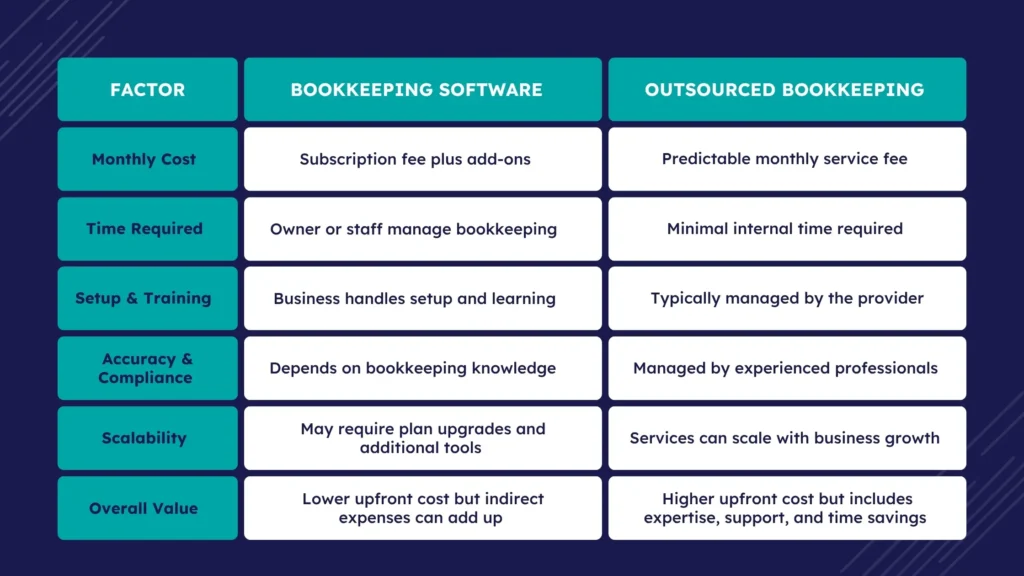
The right choice depends on more than price. A business with simple bookkeeping needs may find software sufficient, while a growing company may benefit from the time savings and expertise that outsourced bookkeeping provides.
When DIY Software Still Makes Sense
Bookkeeping software remains an excellent option for many Canadian businesses, particularly during the early stages of growth. Businesses with relatively simple operations often find that small business bookkeeping costs Canada remain manageable when transaction volumes and reporting requirements are limited.
Managing your own bookkeeping may be a practical choice if you:
- Operate as a sole proprietor or freelancer.
- Have relatively few transactions each month.
- Don’t have employees or payroll obligations.
- Have straightforward GST/HST reporting requirements.
The key is maintaining consistent bookkeeping habits rather than allowing records to accumulate until month-end or year-end, which can lead to unnecessary Bookkeeping cleanup later.
When Outsourcing Becomes the Cheaper Option
As a business grows, bookkeeping often becomes more time-consuming and complex. At a certain point, the value of professional support may outweigh the savings from managing everything internally. Comparing QuickBooks vs outsourced bookkeeping is often most useful when a business needs more than basic transaction recording and requires ongoing financial reporting support.
Outsourcing often becomes more cost-effective when your business:
- Processes a high volume of monthly transactions.
- Has employees and regular payroll responsibilities.
- Manages inventory across one or more locations.
- Operates multiple revenue streams.
- Needs better cash flow visibility.
For many businesses, the biggest benefit isn’t simply reducing bookkeeping costs; it’s freeing up time while improving the accuracy and consistency of financial records through virtual bookkeeping solutions.
How to Calculate Your True Bookkeeping Cost
To compare the cost of bookkeeping software vs outsourcing, calculate your total bookkeeping cost, not just your software subscription. Include expenses such as add-ons, third-party integrations, staff training, implementation, year-end accountant cleanup, and the value of the time you or your employees spend managing the books. Calculating the true cost of DIY bookkeeping requires factoring in both direct expenses and the value of the time invested in managing the books internally. For example, if bookkeeping takes 8 hours per month and your time is worth CAD 75 per hour, that’s an additional CAD 600 per month before software costs. Factoring in both direct and indirect expenses provides a more accurate comparison and helps you make a better-informed decision. For additional financial management guidance, the Business Development Bank of Canada (BDC) offers helpful resources for Canadian small businesses.
Common Mistakes Businesses Make
Businesses often spend more on bookkeeping than necessary because they focus on the wrong costs.
Some of the most common mistakes include:
- Choosing bookkeeping software based solely on the lowest subscription price.
- Underestimating the cost of add-ons and software upgrades.
- Ignoring implementation and staff training expenses.
- Waiting too long to seek professional bookkeeping support.
Failing to evaluate the hidden costs of bookkeeping software can lead to a higher total bookkeeping expense than originally expected.
Conclusion
There is no one-size-fits-all answer to the cost of bookkeeping software vs outsourcing. While bookkeeping software may be cost-effective for businesses with simple needs, growing businesses should also consider the hidden costs of add-ons, staff time, and maintaining accurate financial records. Instead of focusing solely on the monthly subscription, evaluate the total cost of ownership to determine the best long-term value. Evaluating outsourced bookkeeping cost Canada alongside software fees, staff time, and year-end cleanup costs can lead to a more accurate long-term decision. If you’re unsure which option is right for your business, contact the team at NCSGX to discuss your bookkeeping needs and explore a solution tailored to your goals.
How NCSGX Can Help
Choosing the right bookkeeping solution depends on your business’s unique needs. At NCSGX, we help Canadian businesses streamline their bookkeeping with professional support tailored to their growth. Whether you use cloud bookkeeping software or prefer to outsource, our team helps maintain accurate financial records, improve compliance, and reduce the time spent managing day-to-day bookkeeping.
Frequently Asked Questions (FAQ)
1. Is bookkeeping software cheaper than outsourced bookkeeping for a small business?
Not always. While software may cost less initially, growing businesses should also consider the cost of add-ons, time, and potential bookkeeping errors before deciding.
2. What is subscription creep in bookkeeping software?
Subscription creep occurs when businesses gradually add paid features like payroll, inventory, or extra users, increasing monthly software costs over time.
3. How much does outsourced bookkeeping typically cost in Canada?
Costs vary by business size and complexity, but many Canadian businesses pay between CAD 300 and CAD 1,500+ per month for outsourced bookkeeping services.
4. At what point should a business consider switching from software to outsourced bookkeeping?
Outsourcing is worth considering when bookkeeping becomes time-consuming, more complex, or requires expertise in areas like payroll, GST/HST, or financial reporting.
5. Can using bookkeeping software alone lead to costly mistakes?
Yes. Software automates tasks but cannot prevent errors such as incorrect data entry, GST/HST coding mistakes, or missed reconciliations.
6. How do I calculate my true bookkeeping cost?
Add your software fees, paid add-ons, training, accountant cleanup costs, and the value of the time spent on bookkeeping to estimate your total cost accurately.