
 USA
USA
 Canada
 Australia

Introduction
What happens when your firm acquires more clients, but your team can’t keep up? Files start piling up, review takes longer, and partners get pulled back into routine work. For many Canadian CPA firms, that is when outsourced accounting for CPA firms starts looking less like an option and more like a serious capacity question.
But before you hand over your work to an outside team, there is a bigger question to answer: is your firm actually ready to outsource? The answer comes down to more than workload. These seven questions will help you look at the processes, privacy, technology, review capacity and client communication issues that can make or break an outsourcing arrangement. NCSGX helps these types of CPA firms strengthen their capacity with professional bookkeeping and accounting support.
Key Takeaways
- Determine whether your workload problem is seasonal or becoming a recurring capacity issue.
- Make sure processes, review procedures and client instructions are clear enough to hand off.
- Assess privacy, confidentiality, technology and access controls before sharing client information.
- Confirm who will review outsourced work and handle exceptions.
- Compare the full economics, including recruitment, training, overtime and management time.
- Decide how client communication will work before an external provider becomes part of the workflow.
Is Your CPA Firm Ready to Outsource? 7 Questions to Ask
More clients, tighter deadlines, and a team already working under pressure can make outsourcing look like the obvious next step. But handing off work before your firm is ready can create new problems instead of solving old ones. Before you make that move, these seven questions will help you see whether your CPA firm has the right processes, people, technology, and oversight in place to outsource confidently.
What Outsourcing Actually Means for a Canadian CPA Firm
Outsourcing does not mean handing over an entire client file and stepping away from the work. In practice, a CPA firm can choose specific tasks to outsource, such as recurring bookkeeping, routine accounting work, or outsourcing tax preparation for accountants, while keeping client communication, professional judgment, review, and final approvals in-house.
The same approach applies to outsourced bookkeeping for accounting firms. An external team can take care of agreed production work while the Canadian CPA firm stays in control of the client relationship, quality standards, and professional oversight. The key is to clearly define what gets handed off, who reviews it, and where the firm’s responsibility begins and ends.

Question 1: Is the Capacity Problem Structural or Seasonal?
Start by identifying why the firm needs additional capacity. A few difficult months before tax deadlines are different from recurring accounting firm capacity issues caused by client growth, staff turnover or an ongoing inability to recruit.
The distinction matters. A firm facing a temporary spike may need short-term support, while a practice with steadily increasing work may need a more consistent capacity planning approach. The accounting staff shortage Canada continues to be a practical consideration for firms that cannot fill production roles quickly enough.
For example, a five-person firm may manage its regular workload comfortably but struggle every spring. Another firm may have work carried forward throughout the year because its client base has grown faster than its production team. Those are different outsourcing decisions.
Question 2: Are Your Processes Documented Well Enough to Hand Off?
Imagine handing a client file to someone new and having to explain every step from your side. Which reports to check, how to handle unusual transactions, where supporting documents are saved, what needs review, and when to raise a question.
If your team relies heavily on individual knowledge rather than a documented process, outsourcing can quickly become frustrating. Before handing off work, make sure your recurring bookkeeping, reconciliations, tax preparation, review steps, file naming, approvals, and client-specific instructions are clear enough for someone outside the firm to follow.
Good documentation does not mean creating a 50-page manual for every task. It means giving the external team enough direction to work consistently without constantly coming back to your staff for basic instructions. That is why this is one of the most practical questions to ask before outsourcing accounting.
Question 3: Can You Meet Client Confidentiality and Privacy Obligations?
When client information leaves your firm’s immediate team, the question is not simply, “Can this provider do the work?” You also need to ask, “Can we trust the way they will handle the information?” Before outsourcing, be clear about what client data will be shared, where it will be stored, who will have access to it, how access is controlled, and what privacy and security protections are built into the arrangement.
For CPA firms working with CRA information, there are some responsibilities of authorized representatives that they should follow. CRA guidance for authorized representatives includes protecting taxpayer information, maintaining security and privacy, and taking care when disclosing information. In other words, outsourcing may change who performs the work, but it does not remove the firm’s responsibility to handle client information appropriately.
Question 4: Is Your Technology Stack Ready for External Access?
Moving to cloud accounting is one thing. Letting an outside team work in that environment is another. A firm may already use QuickBooks Online, Xero, or a cloud document system, but if everyone has broad access, permissions are unclear, or files are shared through different channels, outsourcing can create more confusion than convenience. The goal is to give an external team enough access to do its job without opening the door to everything else.
This is where simple controls make a real difference. Your team should know who approved the access, what the external team can see, and how that access will be monitored. When the assignment ends, access should be easy to remove. In short, technology should make the handoff easier without making your firm lose control of its client information and workflow.
The CRA also states that using a third party to keep business records does not remove the firm’s responsibility for those records.
Question 5: Who Will Review the Work, and Do You Have the Bandwidth?
Outsourcing work does not mean your team no longer needs to check it. Someone at the firm still needs to answer questions, review completed work, fix anything that needs attention, and approve the final file. Before outsourcing, look at who will take on these responsibilities and whether they have enough time to do them properly.
This is important when considering outsourced bookkeeping for accounting firms or outsourcing tax preparation for accountants.
If a partner or senior accountant is already busy, sending them more files to review may not solve the problem. A simple plan for who reviews the work, who handles questions, and who gives final approval can make the whole process easier to manage.
Question 6: Do the Economics Actually Work for Your Firm?
The lowest outsourcing fee is not always the lowest overall cost for a CPA firm. Before deciding, look at what your current team is actually costing you to handle the same work. That can include salaries, overtime, hiring, training, supervision, and the time senior staff spend fixing or reviewing routine work. Then compare that with the outsourcing fee and ask a simple question: what are we getting for the cost?
Offshore accounting staff can be one option for firms looking to add capacity without hiring locally. If you are considering outsourcing accounting work to India, look at the provider’s qualifications, Canadian accounting experience, communication, security, review process, and availability. The value of offshore accounting staff depends on the quality of the work and how well the arrangement fits your firm’s needs, not simply where the team is located.
Question 7: How Will You Communicate This to Clients?
Last but not the least.
This may be the last question, but it is one of the most important ones. You can have the right provider and a well-planned workflow, but if your team cannot clearly explain the arrangement to clients, it can create unnecessary questions or concern.
Before outsourcing begins, decide what work will be handled externally, how client information will be protected, who the client should speak to, and who remains responsible for professional decisions and final review.
For a CPA firm, the main point is straightforward: outsourcing should support the client relationship, not change who owns it. Your firm should remain the clear point of contact for the client, while the external team works in the background where appropriate.
Common Readiness Gaps That Cause Outsourcing to Fail
Outsourcing problems are often operational, not technical. Common gaps include:
- Poorly documented processes and inconsistent client files
- No named internal reviewer or unclear responsibility for exceptions
- Weak permissions, shared credentials, or uncontrolled downloads
- No escalation path for incomplete records or unusual transactions
- Starting with too much work before the process has been tested
- Selecting a provider based only on price
- No regular communication, reporting, or quality-review routine
By identifying these gaps, a CPA firm can identify which bottlenecks are there that stop outsourcing processes from success.
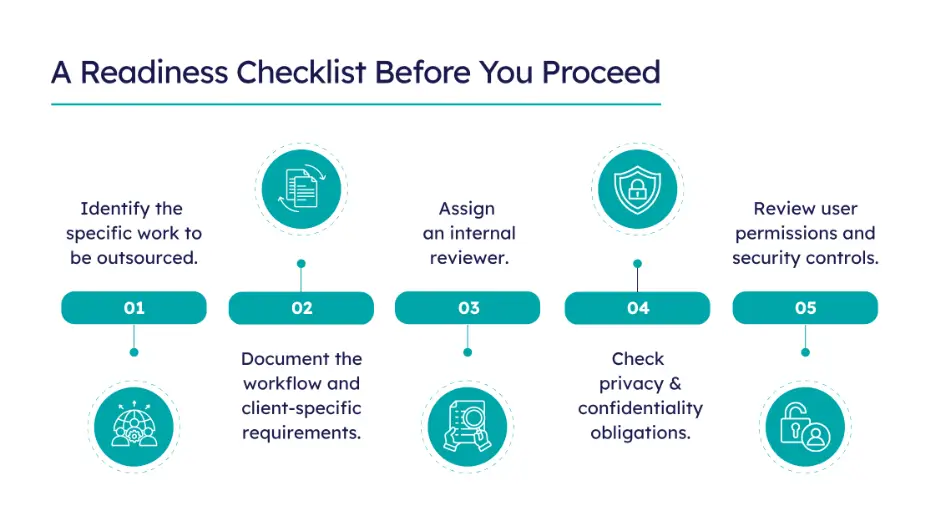
A Readiness Checklist Before You Proceed
Use this checklist when working through the questions to ask before outsourcing accounting:
Conclusion
Being ready to outsource is less about firm size and more about having the right controls in place. If your processes are clear, client information is protected, technology access is managed, review responsibilities are defined, and the costs make sense, outsourcing can become a practical way to add capacity without giving up control of the client relationship.
Start by identifying the work putting the most pressure on your team and consider whether external support could help. If you want to discuss how this could work for your firm, contact us to explore your options.
How NCSGX Canada Can Help
NCSGX Canada can fit into this model as a capacity-extension partner for Canadian CPA firms that need support with defined accounting and bookkeeping production work. The firm can retain client relationships, professional oversight and final review while an external team supports agreed workflows. CPA practices can explore relevant bookkeeping services as part of assessing where additional production capacity may fit within their existing processes.
Frequently Asked Questions (FAQ)
1. Is outsourcing client work permitted under Canadian CPA professional standards?
It can be, but the requirements depend on the engagement and applicable provincial CPA rules. Firms should review confidentiality, engagement terms, professional responsibilities, and any requirements that apply before outsourcing.
2. Does a CPA firm need client consent before outsourcing bookkeeping or tax preparation?
Not always. It depends on the information involved, engagement terms, privacy requirements, and the specific outsourcing arrangement. The firm should check these factors before sharing client information.
3. Who is professionally responsible if outsourced work contains an error?
The CPA firm remains responsible for appropriate oversight of work performed as part of its engagement. The exact responsibilities can vary, so they should be clearly defined before work is handed over.
4. Does outsourcing affect a firm's professional liability insurance coverage?
It can. Before outsourcing, review your policy and speak with your insurer or broker to confirm whether the arrangement affects your coverage or creates any additional requirements.
5. What types of accounting work should a CPA firm not outsource?
Work requiring professional judgment, final approvals, and key client decisions should be handled carefully. What can be outsourced depends on the engagement, applicable requirements, and the firm’s ability to maintain proper oversight.
6. Is outsourcing viable for a small firm with only two or three staff?
Yes. A small firm can outsource recurring work when its team is under pressure or hiring is difficult. The firm still needs clear processes and enough internal capacity to review the work properly.