
 USA
USA
 Canada
 Australia

Introduction
The Ontario small business tax rate change is set to reduce the provincial small business corporate income tax rate from 3.2% to 2.2% effective July 1, 2026. For corporations with a taxation year that crosses this date, the lower rate is prorated based on the number of days before and after July 1.
Understanding this transition is important when preparing your corporate tax return and year-end records. With support from NCSGX, businesses can keep their financial records organized and better prepared for changing tax requirements.
Key Takeaways
- Ontario’s small business corporate income tax rate decreased from 3.2% to 2.2% effective July 1, 2026 for qualifying corporations.
- The Ontario small business tax rate 2026 is 2.2% from July 1, 2026, but corporations with a taxation year crossing this date must calculate a blended rate using the applicable day-count method.
- For a straddling tax year, the Ontario rate must be calculated using the applicable day-count transition method rather than applying one rate to the entire taxation year.
- The resulting prorated small business tax rate depends on the number of days before and after July 1, 2026, making an accurate blended corporate tax rate calculation essential.
- The federal small business tax rate remains 9%, so the combined federal and Ontario small business tax rate is generally 12.2% before the Ontario change and 11.2% after the change, assuming the income qualifies.
Ontario Small Business Tax Rate Change: How to Calculate a Straddling Tax Year
The ontario small business tax rate change reduced Ontario’s lower corporate income tax rate from 3.2% to 2.2% effective July 1, 2026. If your corporation’s fiscal year crosses that date, you cannot simply apply one Ontario rate to the full year. You need to use Ontario’s statutory day-count calculation to determine the deduction and effective provincial rate for that straddling tax year.
This matters for CCPC owners, bookkeepers, accountants, and finance teams preparing 2026 and 2027 T2 returns. The calculation affects Ontario corporate income tax on eligible small business income, but it does not change the federal small business rate or automatically change personal tax on dividends.
What Changed on July 1, 2026
Before July 1, 2026, the Ontario lower corporate income tax rate for qualifying small business income was 3.2%. From July 1, 2026 onward, the ontario small business tax rate july 1 2026 is 2.2%. Ontario’s general corporate income tax rate remains 11.5%.
The federal small business corporate income tax rate remains 9% for qualifying income. Therefore, the combined federal and ontario small business tax rate is 12.2% before the Ontario change and 11.2% after the new Ontario rate applies.
This means the relevant ccpc tax rate 2026 ontario is not automatically 11.2% for every 2026 taxation year. For a year crossing July 1, the Ontario portion is calculated using the statutory day-count method, while the 9% federal rate remains unchanged.
Does This Apply to You? A 30-Second Check
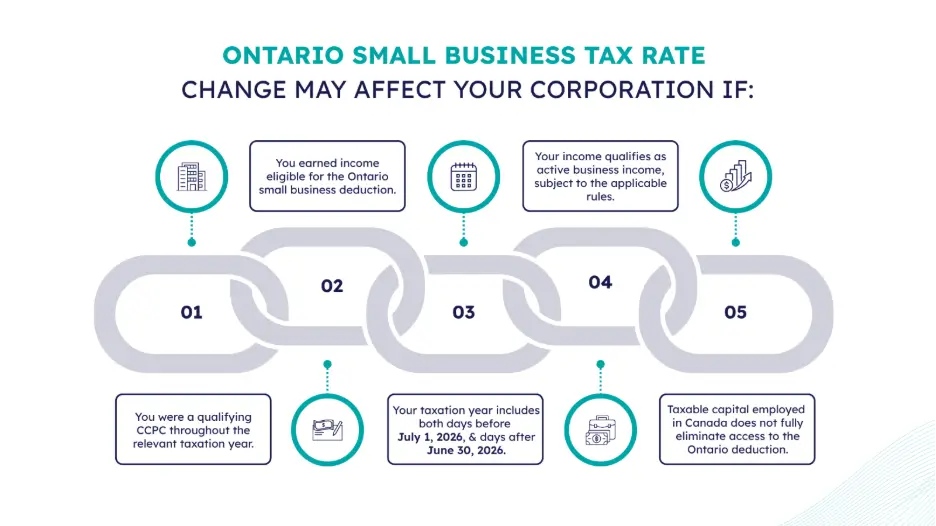
The Ontario small business deduction begins to phase out when taxable capital employed in Canada exceeds $10 million and is completely eliminated at $50 million or more, based on the relevant prior-year rules.
The Day-Count Formula
For a taxation year that straddles July 1, 2026, Ontario’s legislation calculates the small business deduction rate using a ratio of days. The applicable deduction rates are 8.3% for days before July 1, 2026 and 9.3% for days after June 30, 2026.
Official deduction-rate formula:
Ontario SBD rate =
8.3% × (days before July 1, 2026 ÷ total days in taxation year)
+ 9.3% × (days after June 30, 2026 ÷ total days in taxation year)
Because Ontario’s general rate is 11.5%, the resulting lower Ontario rate is effectively the general rate minus the calculated small business deduction rate. This is the statutory basis for the prorated small business tax rate and the resulting blended corporate tax rate calculation.
In practical rate terms, the calculation produces the same day-weighted transition between 3.2% and 2.2%:
Ontario lower rate =
3.2% × (days before July 1 ÷ total days)
+ 2.2% × (days after June 30 ÷ total days)
Three Worked Examples
Example 1: Calendar-Year Corporation
Taxation year: January 1, 2026 to December 31, 2026
Total days: 365
Days before July 1: 181
Days after June 30: 184
Ontario rate:
(3.2% × 181/365) + (2.2% × 184/365) = 2.7041%
The resulting Ontario rate is approximately 2.704%.
Assuming all relevant income qualifies for both small business rates, adding the 9% federal rate gives an approximate combined federal and ontario small business tax rate of 11.704%. This is an illustration of the rate calculation, not a complete corporate tax calculation.
Example 2: April 1, 2026 to March 31, 2027
Taxation year: April 1, 2026 to March 31, 2027
Total days: 365
Days before July 1: 91
Days after June 30: 274
Ontario rate:
(3.2% × 91/365) + (2.2% × 274/365) = 2.4493%
The corporation’s blended Ontario rate is approximately 2.449%. Assuming qualifying income and the full 9% federal small business rate, the combined rate is approximately 11.449%.
This example shows why a straddling tax year can produce a result between the old and new rates.
Example 3: Taxation Year Beginning After July 1
Taxation year: July 1, 2026 to June 30, 2027
Total days: 365
Days before July 1: 0
Days after June 30: 365
Ontario rate:
(3.2% × 0/365) + (2.2% × 365/365) = 2.2%
The full 2.2% Ontario rate applies. With the 9% federal rate, the combined federal and ontario small business tax rate is 11.2%, assuming the income qualifies.

What Does Not Get Prorated
The Ontario rate transition does not change the corporation’s underlying eligibility rules.
The $500,000 Ontario small business limit is not prorated merely because the rate changed on July 1, 2026. It remains an annual limit, subject to associated-corporation sharing, taxable-capital phase-out rules, and other applicable restrictions.
A corporation must still qualify for the small business deduction. The Ontario lower rate is not automatic for every corporation, and income above the available business limit generally remains subject to Ontario’s 11.5% general rate.
Why You Cannot Shift Income into the Second Half
A corporation generally calculates taxable income for its full taxation year. The statutory transition formula then applies to the eligible Ontario small business income for that year.
In other words, a business cannot normally choose to label particular invoices, sales, or profits as “post-July 1 income” to receive the 2.2% rate. Ontario’s blended corporate tax rate calculation is based on days in the taxation year, not when the corporation earned individual items of revenue.
Checking the Blended Rate on Your T2
Ontario corporate income tax is reported through the T2 return and related schedules. CRA guidance identifies Schedule 500, Ontario Corporation Tax Calculation, as the worksheet used to calculate Ontario basic income tax and the Ontario small business deduction. Schedule 500 itself does not have to be filed with the return.
For a straddling tax year, review the taxation-year dates, the day count and the version of the applicable forms or tax software. Your preparer should ensure the return reflects the current transition rules rather than applying one Ontario lower rate to the entire year.
Two Things to Review Before Your Year-End
- Confirm your small business rate eligibility. Review active business income, your available small business limit, associated corporations and taxable capital. A lower ccpc tax rate 2026 Ontario applies only where the corporation and income meet the relevant conditions.
- Confirm your dates and records. Verify the exact start and end of the taxation year, check the daycount and ensure Bookkeeping records support the figures used in T2 preparation. This is a good time to review your year-end bookkeeping guide before finalizing the corporate tax calculation.
Conclusion
The Ontario small business tax rate change makes accurate year-end planning especially important for corporations with a taxation year crossing July 1, 2026. Instead of applying one rate to the entire year, eligible businesses need to use the correct transition calculation and confirm that their corporate tax return reflects the current rules.
A careful review of your eligibility, day count, and tax calculation can help avoid costly errors. If you need support with your bookkeeping or year-end financial records, Contact us to discuss how NCSGX can help you stay organized and prepared.
Frequently Asked Questions (FAQ)
1. Do I use 11.2% or 11.7% for my 2026 tax year?
Neither automatically. Before July 1, the combined rate is 12.2%, and from July 1, it is 11.2%. A straddling tax year requires a blended Ontario rate.
2. When does the Ontario small business tax rate change take effect?
The Ontario small business tax rate decreases from 3.2% to 2.2% effective July 1, 2026.
3. My year-end is June 30, 2026, do I need to blend?
No. Your taxation year ends before the new rate takes effect, so the 3.2% Ontario rate applies, subject to eligibility.
4. Is the $500,000 small business limit also prorated?
No. The rate change does not prorate the $500,000 limit, although other eligibility rules may affect the amount available.
5. What rate applies if my fiscal year ends in 2027?
It depends on your taxation-year dates. A year that crosses July 1, 2026 requires a blended rate, while a year entirely after that date uses the 2.2% Ontario rate, subject to eligibility.
6. Does this change how much personal tax I pay on my dividends?
Not directly in 2026. The change affects corporate tax, while personal tax on dividends depends on separate dividend tax rules.