
 USA
USA
 Canada
 Australia


Introduction
AI in financial forecasting has moved from pilot project to standing infrastructure. Finance functions that used to close the books and then spend a week rebuilding a spreadsheet model now run continuous, machine-assisted forecasts that update as new data lands. Used well, the tools sharpen accuracy, compress the forecast cycle, and surface patterns a human analyst would never have the hours to find.
Used carelessly, they do something more dangerous than a bad spreadsheet: they produce a confident, precise-looking number that is quietly wrong. The gap between a forecast you can act on and one that misleads you rarely comes down to the algorithm. It comes down to how the finance team uses it.
Here is what separates the two, framed as the do’s and don’ts we see decide the outcome.
Why AI is reshaping the forecast
Traditional forecasting leaned on historical trends, manual adjustment, and a lot of analyst judgment applied one cell at a time. That approach struggles once data volume and business complexity grow past a certain point.
Machine learning forecasting handles that scale differently. It ingests large, messy datasets, detects non-obvious relationships between variables, and re-forecasts continuously rather than once a quarter. Adoption across the profession is already well underway; KPMG’s analysis of AI in financial reporting and audit tracks how quickly finance functions are moving from experimentation to embedded use. It can weight real-time signals, run hundreds of scenarios in the time a person builds one, and flag anomalies as they emerge. For most finance teams, the value of AI for finance is not that it replaces the analyst. It is that it gives the analyst a faster, wider, more responsive starting point.
That starting point still needs governing. Which brings us to the do’s.
The Do’s
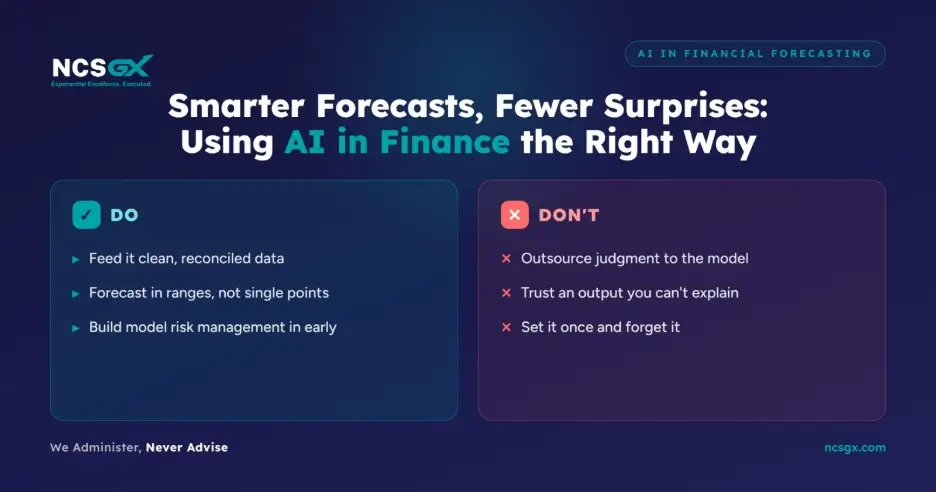
Do start with clean, governed data. A forecasting model is only as good as what feeds it. Duplicate transactions, unreconciled accounts, inconsistent categorisation, and gaps in history all pass silently into the output and come back out as a number no one questions. Before the model matters, the data pipeline matters. Reconciled ledgers, consistent chart-of-accounts mapping, and a documented source of truth are not glamorous, but they are where forecast accuracy is actually won or lost.
Do keep a human in the loop. The most reliable AI in financial planning treats the model as one input into a human decision, never as the decision itself. A machine can tell you what the pattern suggests. It cannot tell you that a key customer is about to churn, that a regulatory change lands next quarter, or that last year’s spike was a one-off you should exclude. Finance judgment sits on top of the output, not underneath it.
Do forecast in ranges, not single points. A model that returns “revenue will be 4,412,900” invites false confidence. A model that returns a base case, an upside, and a downside with the assumptions behind each is far more useful for planning. Scenario ranges keep the conversation honest and keep leadership focused on decisions rather than on defending a single digit.
Do build model risk management in from day one. This is the discipline that keeps a forecasting program trustworthy over time: validating the model against actual outcomes, documenting its assumptions and limitations, monitoring it for drift, and defining who owns it. Model risk management is not a compliance afterthought. It is the difference between a model you understand and a black box you have quietly started to trust for reasons you can no longer explain.
Do match the technique to the question. Short-horizon cash forecasting, long-range strategic planning, and demand-driven revenue modelling are different problems. The right approach for one can perform poorly on another. Choosing the tool to fit the horizon and the decision, rather than applying one model to everything, is a mark of a mature program.
Do keep the forecast explainable. If you cannot articulate why the model produced a number, you cannot defend it to a board, an auditor, or a lender. Favour approaches and documentation that let you trace an output back to its drivers. Explainability is what turns a forecast from a curiosity into something you can actually build a plan on.
The Don’ts
Don’t outsource judgment to the model. Overreliance is the single most common failure. AI excels at processing data and detecting patterns; it does not understand context, intent, or the parts of your business that never made it into the dataset. When the model becomes the reason rather than an input to the reasoning, the finance function has stopped adding value and started laundering the output.
Don’t feed sensitive financial data into consumer AI tools. Pasting ledgers, forecasts, or client information into public chatbots or ungoverned tools is a confidentiality and data-security risk, and often a contractual or regulatory breach. Any AI used in finance needs a clear answer to where the data goes, who can see it, and how it is retained. If you cannot answer that, the tool does not touch real numbers.
Don’t treat a black box as fact. A model that cannot explain itself is not more sophisticated; it is less accountable. If no one on the team can say why the forecast changed, you have introduced risk, not removed it. Precision on screen is not the same as accuracy in reality.
Don’t set it and forget it. Models drift. The relationships a model learned last year degrade as markets, pricing, customer behaviour, and cost structures shift. A forecast that was reliable in stable conditions can quietly decay and then fail hardest in exactly the moment you needed it, a market shock or a downturn. Continuous monitoring and periodic revalidation are non-negotiable, and a recognised framework such as the NIST AI Risk Management Framework gives finance teams a structured way to govern the model over its whole lifecycle rather than just at launch.
Don’t confuse correlation with causation. Machine learning is very good at finding patterns, including patterns that mean nothing. A variable that happened to track revenue for three years may have no causal link at all. Without human review, a model will happily build a forecast on a coincidence.
Don’t skip stress and edge-case testing. A model that performs well on normal months can behave unpredictably at the extremes, the large one-off transaction, the seasonal spike, the recessionary quarter. Test it against the hard cases and the historical shocks before you rely on it for the decisions that matter most.
Model risk management is where programs live or die
Most forecasting failures are not model failures. They are governance failures. The organisations that get lasting value from AI in financial forecasting treat model risk management as an operating discipline: every model has an owner, a documented purpose, stated assumptions and limitations, a validation record against actual results, and a monitoring routine that catches drift before it reaches a board pack.
That framework does more than protect you. It builds the confidence to actually use the forecast. When you can show how a number was produced, where its limits are, and how it has performed, the output stops being a black box you hope is right and becomes a tool you can plan around.
Where AI fits in financial planning
The strongest use of AI in financial planning is inside the FP&A cycle, not around it. Rolling forecasts that update continuously, variance analysis that flags the exceptions automatically, and scenario modelling that lets leadership pressure-test a decision in minutes rather than days. The same shift is playing out in advice, where AI is reshaping investment management workflows in much the same way. The technology absorbs the mechanical load so the finance team can spend its time on interpretation and judgment, which is the part no model can do for you.
The principle underneath every one of these do’s and don’ts is the same: AI for finance is a capability that raises the ceiling on what a finance function can do. It does not lower the bar on the discipline required to do it well.
Conclusion
AI in financial forecasting rewards discipline more than enthusiasm. The teams that get real value from it do the unglamorous things well: they feed the model clean data, forecast in ranges, keep a human accountable for every output, and treat model risk management as an ongoing routine rather than a one-time setup. The technology raises the ceiling on what a finance function can do, but it never lowers the bar on the judgment required to do it well. Get the foundations right and AI becomes an edge you can trust. Skip them and it becomes a confident-looking liability.
If you want your finance operations ready to support that kind of forecasting, contact us and we will help you start with the data and reporting groundwork that makes everything above possible.
How NCSGX supports AI-ready finance functions
AI does not fix a shaky foundation; it scales it. That is where NCSGX fits. We administer, never advise, which means we do not tell you what your forecast should say. We build and run the operational layer that makes a reliable forecast possible.
That includes the work that quietly determines forecast quality: reconciled ledgers and clean, consistent data feeding the models; management and variance reporting produced on time and to a standard through our CFO and finance-accounting support; and the day-to-day back-office execution that frees your finance team to focus on review, judgment, and the human oversight every model needs. When your data is trustworthy and your team has the capacity to interpret rather than just process, your AI tools finally have something solid to stand on. For a fuller picture of how that model works in practice, see our guide to outsourcing your finance operations.
If you are building or scaling AI in your forecasting process and want the underlying finance operations to keep pace, that is the conversation to have. Start with a review of your data readiness and reporting cadence and build the governance out from there.

Bijal Bodiwala
Bijal Bodiwala is a Chartered Accountant with over 10 years of experience at NCSGX Australia, where he serves as AVP - Accounting & Bookkeeping. He specialises in bookkeeping, BAS and IAS, GST, payroll and STP reporting, financial reporting, and management accounts for Australian accounting firms and SMEs. With command of Australian tax frameworks and tools like Xero, MYOB, and QuickBooks Online, he has driven 50-70% reductions in operating costs for top firms, delivering scalable, partner-ready solutions.
All Posts