

 USA
USA
 Canada
 Australia


Every second, the world moves millions of payments, and increasingly an algorithm has a hand in each one. AI in payments technology has quietly become the layer that decides whether a transaction is safe, how it should be routed, and how fast it can settle. For businesses sending and receiving that money, and the finance teams accounting for it, this is one of the most consequential shifts in modern finance. At NCSGX, we work in the back office where those payments land for accounting firms and finance teams across regions, which gives us a clear view of what the technology changes in practice.
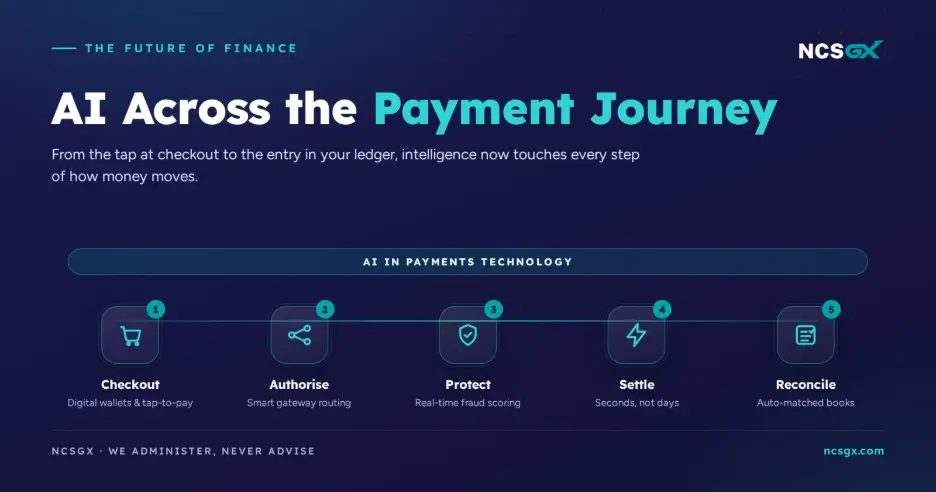
The story isn’t a single breakthrough. It’s the steady spread of intelligence across the whole payment journey, from the tap at checkout to the entry in the ledger.
From reactive to predictive
The old payments stack was reactive. Fixed rules approved or blocked a transaction, batch files moved overnight, and problems surfaced days later at reconciliation. Fintech AI flips that. Models now read each transaction in context and act in the moment: predicting which payments will fail, spotting the anomaly that signals fraud, and matching a messy remittance to the right invoice before a human ever sees it. That move from reacting to predicting is the thread running through everything below.
Speed that reshapes cash flow
Real-time has become the global default. Instant systems like India’s UPI, Brazil’s Pix, the UK’s Faster Payments, Europe’s SEPA Instant, and the FedNow service in the US now move money between accounts in seconds, and digital wallets have brought hundreds of millions of new users into digital payments. As the World Bank’s Global Findex documents, adoption has surged across developed and emerging markets alike. Cross-border remains the stubborn exception, slower and pricier than domestic payments. Industry bodies such as the Bank for International Settlements are pushing faster rails and the ISO 20022 standard, with AI screening for sanctions and fraud so speed doesn’t come at the cost of control. For a business, the effect is immediate: money that once sat in transit for days now arrives at once, and the books have to keep pace.Trust at machine speed
Speed is only useful if it’s safe, and fraud is where AI proved itself first. Rules-based checks worked like a bouncer with a fixed list, block the large amount, flag the overseas card, and turn away plenty of genuine customers by mistake. Machine-learning models instead learn what normal looks like for each account and flag the quiet deviation. Behavioural signals like typing speed and device handling feed real-time scoring that approves good payments faster and stops suspect ones without a human in the loop, even on rails that settle in seconds.Smarter money movement
Between checkout and settlement sits a chain of payment processing decisions most people never notice, and AI now optimises each one. A modern payment gateway can choose in real time which connection is most likely to be approved, retry a failed charge at the smartest moment, and tokenise card details for secure repeat billing. Embedded finance folds all of this inside the software a business already uses, so the payment and its record arrive together, structured and ready to reconcile rather than two disconnected events.The autonomous horizon
The next step is money that acts within set limits rather than waiting for a manual instruction. J.P. Morgan’s research on smart, autonomous money describes payments triggered by software agents under human-defined rules, from restocking inventory to paying a supplier the moment goods arrive. Programmable money, stablecoins, and central bank digital currencies point the same way, embedding logic directly into the payment. It’s a future that rewards clean data and clear controls.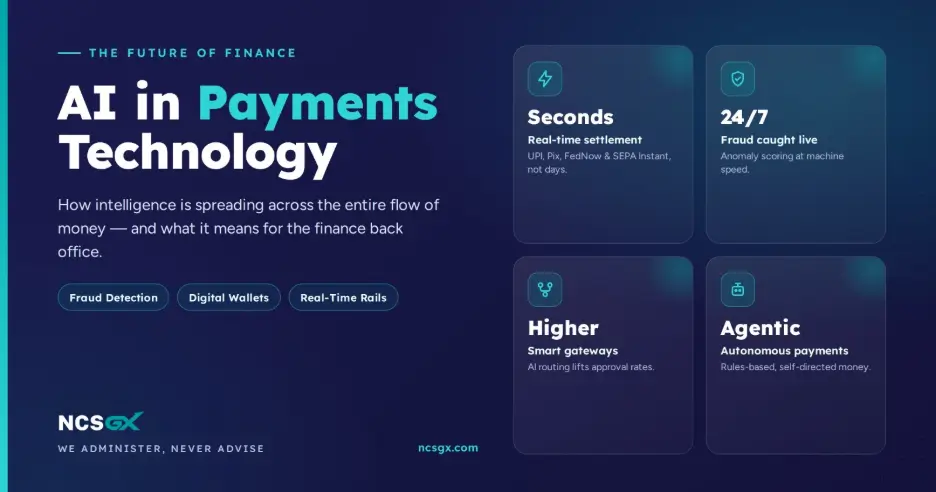
Where finance teams feel it
For all the front-end change, the deepest impact lands in the back office. When payments settle instantly and carry rich data, accounting for them changes shape. AI can match receipts to invoices automatically and learn from every correction, which is the daily reality behind outsourced bookkeeping and reconciliation: volumes rise while manual matching falls. The same intelligence flags duplicate invoices and schedules payments, making accounts payable and receivable an early win, and it feeds tighter forecasting and steadier payroll processing across currencies and entities.
How NCSGX supports the shift
Faster, smarter payments only pay off if the back office keeps up, and that’s the part we run. NCSGX manages the finance operations beneath the payment technology so the intelligence in the rails is matched by accuracy in the books: reconciliation cleared daily instead of at month-end, payables and receivables kept current, payroll delivered on schedule, and clean records feeding the forecasting AI-driven finance depends on. We work as an extension of accounting practices, advisers, and finance teams worldwide. We administer; we don’t advise on which platform to buy or strategy to run, and that line is deliberate. What you get back is a finance function that absorbs rising volumes without the backlog, the late nights, or the errors that creep in when a team is stretched.
Conclusion
AI in payments technology isn’t one product you switch on. It’s intelligence spreading across the entire flow of money, making payments faster, safer, and increasingly self-directed. The visible wins are at the checkout and the wallet; the lasting ones are in the back office, where instant payments demand cleaner, faster books.
If your transaction volumes are outrunning your back office, that’s worth a conversation. Book a back-office review with our team to see where AI-ready processes could ease the load on your finance function.
Frequently Asked Questions (FAQ)
1. What does AI actually do in payments technology?
It handles the work that needs speed and pattern recognition: scoring fraud risk in milliseconds, retrying failed payments at the right moment, routing transactions for the best chance of approval, and matching payments to invoices. Most of it runs invisibly inside the gateways and accounting tools already in use.
2. Are AI-driven payments secure?
Yes, and generally more so than the rules they replaced. Models learn each account’s normal behaviour and flag what breaks the pattern, and combined with tokenisation and behavioural signals, they approve genuine payments faster while stopping suspect ones. That’s part of why fraud per dollar spent has fallen even as digital payments have grown.
3. How does AI improve payment processing and gateways?
A modern payment gateway uses AI to pick the connection most likely to be approved, time retries on failed charges, and route recurring billing efficiently, which means fewer failed transactions, fewer false declines, and data that arrives ready to reconcile.
4. What does it mean for accountants and finance teams?
Reconciliation, payables, and cash flow work become far more automated, so professionals shift toward review, exceptions, and judgement. It raises the value of clean data and solid back-office processes rather than removing the need for them.
5. Will AI replace human oversight?
No. AI carries the volume and speed, but people still set the rules, review exceptions, and own the judgement calls, especially around compliance. The direction is autonomous payments within human-defined limits, not payments left unwatched.

Utsavi Bhatia
Utsavi Bhatia is a seasoned financial services professional serving as AVP - Paraplanning at NCSGX. She specialises in delivering high-quality paraplanning support to financial advisers and planning firms across Australia, covering Statement of Advice (SOA) preparation, portfolio analysis, research, and risk profiling. With a strong grasp of the Australian financial planning landscape and platforms like Xplan and Midwinter, she helps advisory businesses streamline back-office operations and reduce turnaround times significantly. Utsavi has supported numerous practices in scaling their service capability without adding overhead, making her a trusted partner to some of Australia's leading financial advice businesses
All Posts