

 USA
USA
 Canada
 Australia


Introduction
For most of their history, contact centres scaled the only way they could: by adding people. More volume meant more seats, more shifts, and more supervisors. That model is now under pressure from every direction at once. Customers expect instant answers at any hour. Hiring and retaining agents has become harder and more expensive, and the routine questions that fill a queue rarely justify a human touch. This is the gap that virtual agents in contact centres are built to close, and it is where a partner like NCSGX helps enterprises rethink how service gets delivered.
A virtual agent is no longer a scripted menu or a rigid FAQ bot. In 2026 it is a conversational system that understands intent, pulls from live business data, and resolves a customer’s request end to end across chat, voice, email, and messaging apps. Used well, it absorbs the predictable volume so that human agents can spend their time where empathy and judgment actually matter. This guide explains what virtual agents are, how they work, the benefits they deliver, and how to deploy them without repeating the mistakes that have stalled so many early rollouts.
What Are Virtual Agents in Contact Centers?
A virtual agent is an AI-powered system that holds a natural conversation with a customer and completes a task on their behalf. Where a traditional chatbot follows a decision tree and hands off the moment it hits something unexpected, a modern virtual agent interprets what the customer means, asks clarifying questions, retrieves the relevant account or order information, and takes action, such as checking a delivery status, processing a return, or resetting a password. IBM’s overview of how virtual agents interpret intent and context is a useful primer on the underlying capabilities that separate these systems from the rules-based bots that came before them.
The distinction matters because expectations have shifted. Customers no longer judge a virtual agent against a phone tree; they judge it against the fastest, most helpful interaction they have ever had. That raises the bar for what “good” looks like, and it is why the term AI virtual agent has largely replaced “chatbot” in serious contact center conversations.
Virtual Agents Versus Chatbots and IVR
It helps to be precise about what changed. Legacy tools handled interactions in fixed steps. An interactive voice response (IVR) system routed callers through numbered options. A first-generation chatbot matched keywords to canned responses. Both worked as deflection mechanisms, keeping simple queries out of the queue, but neither could reason, and both frustrated anyone whose question fell outside the script.
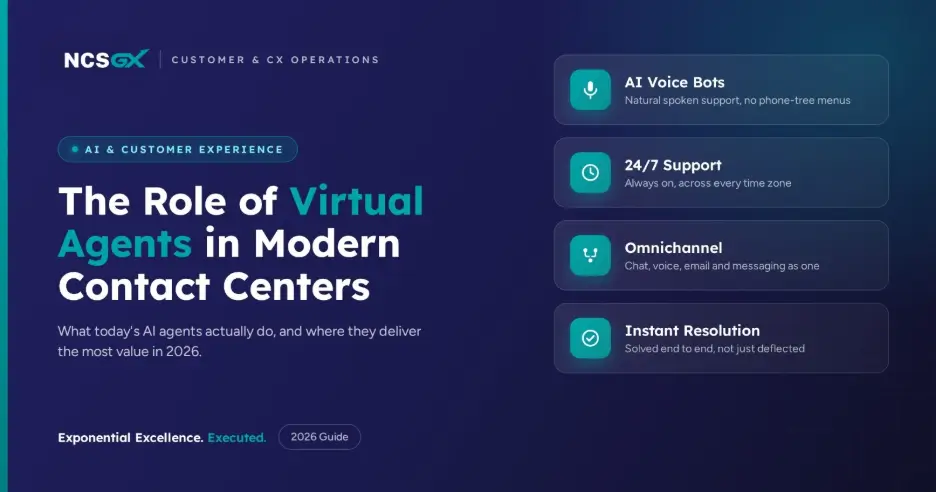
Modern virtual agents differ in three ways. They understand unstructured language rather than keywords, so a customer can describe a problem in their own words. They connect to core systems, such as CRM, order management, and knowledge bases, so answers reflect real, current data rather than generic content. And they act rather than merely inform, completing the transaction instead of pointing the customer toward a form. The result is a shift from deflection to genuine resolution, which is the single most important idea in modern customer experience design.
The 2026 Contact Center Landscape
The scale of adoption is now hard to overstate. Industry research indicates that roughly 88% of contact centers already use some form of AI, though only about a quarter have fully integrated it into daily operations, which is where most of the value is still being left on the table. Gartner has projected that conversational AI could reduce contact center agent labor costs by around 80 billion dollars in 2026, while independent analysts put the cost of an AI-handled voice interaction at a fraction of a dollar against roughly seven to twelve dollars for a live call.
Demand is pulling in the same direction as economics. A large majority of consumers now expect service to be available around the clock, and while most still say they prefer a human for complex issues, a growing share prefer a bot when speed is what they care about. Forrester’s outlook on where customer service is heading in 2026 reinforces the pattern analysts across the market are seeing: automation is moving out of the pilot phase and into the core of how service organizations operate.
The signal in all this noise is not that AI is replacing the contact center. It is that the centers treating virtual agents as a resolution engine, rather than a cost-cutting deflection tool, are the ones reporting real gains in satisfaction and efficiency.
Key Benefits of Virtual Agents in Contact Centers
Always-on availability: The most immediate benefit is genuine 24×7 support. A virtual agent does not sleep, take breaks, or clock off at the end of a shift, which means a customer in a different time zone at two in the morning gets the same quality of help as one who calls during business hours. For global brands, this closes the coverage gaps that used to require expensive overnight staffing.
Lower cost to serve: Because a virtual agent handles high-volume, low-complexity contacts autonomously, the cost per interaction falls sharply. Just as importantly, it protects margins without the boom-and-bust of over-hiring for seasonal peaks and then carrying that cost through quiet periods.
Faster resolution: When a virtual agent is properly integrated, it answers instantly and resolves the request in a single interaction, lifting first-contact resolution and cutting the average handle time that drives most contact center costs.
Effortless scalability: Volume spikes, a product recall, a billing cycle, a viral moment, no longer break the queue. A virtual agent scales to thousands of simultaneous conversations without a corresponding jump in headcount.
A better job for human agents: By absorbing repetitive tickets, automation leaves people to handle the complex, sensitive, and high-value conversations that actually use their skills. That tends to improve both morale and retention in a role long defined by burnout.
Consistency and compliance: Every customer receives the same accurate, policy-aligned answer, and every interaction is logged. For regulated industries, that auditable consistency is a benefit in its own right.
Where Virtual Agents Deliver the Most Value
The strongest use cases share a profile: high frequency, clear intent, and a data-backed answer. Order and delivery status, appointment scheduling and rescheduling, password resets and account unlocks, returns and refunds, billing questions, and eligibility or enrollment checks are all natural fits. In technical environments, a virtual agent can resolve common tier-one issues before they ever reach an engineer, complementing a well-run outsourced IT service desk rather than competing with it.
The point is not to automate everything. It is to automate the right things, the interactions where a fast, correct, self-service answer genuinely serves the customer better than waiting in a queue, and to route everything else to a person cleanly.
Voice Bots and the Rise of the AI Virtual Agent on the Phone
For years, automation lived mostly in chat while the phone stayed human. That is changing fast. Modern voice bots can hold a natural spoken conversation, understand accents and interruptions, and complete transactions over the phone with none of the rigidity of old IVR menus. Because inbound voice, answering calls rather than making them, is where the clearest return sits, receptionist and support-line use cases have become the beachhead for voice automation. Salesforce’s breakdown of how agentic systems handle voice and action is a good reference point for how far spoken automation has moved beyond the phone tree.
The economics are stark: an AI-handled call can cost cents where a human call costs several dollars, which is why a large share of major enterprises are expected to deploy voice AI across their operations by the end of 2026. But the same rule applies as in chat, a voice bot that transfers a caller without context, forcing them to repeat everything, destroys the very experience it was meant to improve.
Getting Virtual Agents Right: Resolution, Not Deflection
Most disappointing rollouts fail for the same handful of reasons, and they are worth naming plainly. The first is designing deflection instead of resolution, tuning the system to reduce queue volume rather than to solve the customer’s problem, which lowers ticket counts while quietly eroding satisfaction. The second is siloed architecture, where a bolt-on bot loses all context the moment it escalates, so the customer starts over with a human. The third is poor data quality, where the agent draws on outdated or unstructured knowledge and confidently gives wrong answers, which corrodes trust faster than no automation at all.
The organizations that succeed do the opposite. They define success as end-to-end resolution without human intervention. They deploy on unified platforms where self-service and live agents share the same context and data. And they invest in the knowledge base and process mapping that determines whether the agent’s answers are right. The technology is rarely the hard part; the operating discipline around it is.
The Human-Plus-AI Contact Center
It is worth being clear about where this is heading, because the fear of wholesale replacement is largely misplaced. The evidence points to a hybrid model: AI absorbs routine volume, and humans handle the complex, emotional, and high-stakes work that automation should not touch. Most service leaders adopting AI have kept their staffing stable and redirected people toward higher-value interactions rather than cutting headcount. The best contact centers in 2026 are not the most automated ones; they are the ones that have drawn the line between machine and human work in the right place, and made the handoff between them invisible to the customer.
Conclusion
Virtual agents have moved from experiment to infrastructure. In the modern contact center they are no longer a novelty bolted onto the edge of the queue; they are the layer that absorbs routine volume, delivers genuine 24×7 support, and lets human agents focus on the conversations that need a person. The organizations pulling ahead in 2026 are not simply the most automated ones. They are the ones that deployed for resolution rather than deflection, kept automation and live support on a single connected platform, and drew the line between machine and human work in exactly the right place.
The question facing most service leaders, then, is no longer whether to adopt virtual agents, but how to deploy them in a way that genuinely improves the customer experience rather than quietly degrading it. That comes down to clean data, well-mapped journeys, sound escalation logic, and a delivery model that treats the technology as one part of a wider operating design. Get those fundamentals right, and virtual agent services stop being a cost-cutting gamble and become a durable advantage, better experiences for customers, better work for agents, and a lower cost to serve. This is precisely the outcome NCSGX is built to execute.
How NCSGX Approaches Virtual Agent Services
Deploying a virtual agent is a business transformation, not a plug-in. It touches data, processes, systems, and the people whose roles change when the routine work goes away. NCSGX designs and operates that full picture, combining conversational AI with skilled human agents inside our omnichannel contact center solutions so that automation and live support run on the same platform, share the same context, and hand off seamlessly.
The approach is deliberately outcome-first. We map which journeys should be automated, integrate the virtual agent with your core systems so its answers reflect live data, build the knowledge and escalation logic that separates resolution from frustration, and staff the human layer that handles everything automation should not. The measure of success is not how many tickets were deflected; it is whether customers left the interaction with their problem actually solved, at a cost and speed that would have been impossible with people alone.
Frequently Asked Questions (FAQ)
1. What is a virtual agent in a contact center?
A virtual agent is an AI-powered system that holds a natural conversation with a customer and completes their request end to end, across chat, voice, email, and messaging, without a human. Unlike a scripted chatbot, it understands intent, connects to live business systems, and takes action, escalating to a person only when a query genuinely needs human judgment.
2. How is a virtual agent different from a chatbot?
A traditional chatbot follows a fixed decision tree and hands off as soon as it hits something outside its script. A modern virtual agent interprets unstructured language, pulls current data from systems like CRM and order management, and resolves the request itself. The shift is from deflection, keeping queries out of the queue, to genuine resolution.
3. Can virtual agents provide 24x7 support?
Yes. Around-the-clock availability is one of their clearest benefits. A virtual agent handles requests at any hour without shift costs, giving customers in every time zone the same fast, consistent help and closing the overnight coverage gaps that used to require expensive staffing.
4. What are voice bots and how do they fit in?
Voice bots are virtual agents that operate over the phone, holding a natural spoken conversation and completing transactions without the rigidity of old IVR menus. They are one of the fastest-growing areas of contact center automation because an AI-handled call costs a fraction of a live one, particularly for inbound support and receptionist-style calls.
5. Will virtual agents replace human contact center agents?
No. The dominant model is human-plus-AI. Automation absorbs routine, high-volume contacts while people handle complex, sensitive, and high-value conversations. Most organizations adopting AI have kept staffing stable and shifted their people toward higher-value work rather than reducing headcount.
6. How do I choose a virtual agent services partner?
Look for a partner that treats the virtual agent as part of a wider operating model, not a standalone tool. The right provider maps which journeys to automate, integrates the agent with your core systems, builds proper escalation and knowledge logic, and runs the human layer alongside it, measuring success by resolution and customer satisfaction rather than deflection alone.

Rajesh Undhad
Rajesh Undhad, AVP of Information Technology at NCSGX, has 12+ years of experience in IT security, infrastructure, and compliance. He oversees the company's IT ecosystem across all international operations, ensuring data security, privacy, and resilience, with expertise in ISO 27001, network security, and global data protection.
All Posts