
 USA
USA
 Canada
 Australia


Canadian accounting firms built it around advice, tax planning conversations, CFO-level thinking, and growth strategy for clients who trust them. But somewhere between onboarding new clients and keeping up with CRA deadlines, the books started consuming the calendar. Outsourced bookkeeping is how forward-thinking firms take that time back.
This a genuine operating model shift that firms across Canada are using to scale advisory revenue without adding headcount proportionally.
Why Bookkeeping Eats So Much Firm Capacity
The volume problem is real. According to a BDC survey on Canadian SME productivity, administrative and compliance tasks consistently rank among the top time drains for professional service firms. For accounting practices, that pressure lands squarely on bookkeeping.
A mid-sized firm managing 80 to 120 client files faces a recurring workload that is difficult to predict and harder to batch efficiently. Bank feeds need review. Expense categorisations need correction. GST/HST reconciliations surface errors at the worst moments. Payroll bookkeeping entries need to match remittances. None of this is complex work. But it compounds fast.
The staff cost is a hidden issue. When a $90,000-per-year senior accountant spends 40% of their week on bookkeeping production tasks, the firm is paying advisory rates for transactional output. That is an expensive operational leak that outsourced bookkeeping for CPA firms directly addresses.
Key Takeaways
- Bookkeeping workflow outsourcing frees senior staff for higher-margin advisory work
- A well-structured outsourced model covers transaction coding, reconciliations, GST/HST and payroll bookkeeping, and reporting prep
- Security, quality control, and PIPEDA compliance are manageable with the right partner
- Canadian firms using outsourced bookkeeping typically reclaim 15 to 25 hours per month, per client file
- Starting the transition does not require disrupting current client relationships
What Outsourced Bookkeeping Actually Covers
There is a common misconception that outsourcing only handles the most basic data entry. In practice, a capable, outsourced bookkeeping engagement covers the full production layer of client file management:
- Transaction coding and categorisation across bank and credit card feeds
- Monthly and quarterly bank reconciliations
- GST/HST and payroll bookkeeping entries, reconciled against source remittances
- Accounts receivable and payable tracking
- Intercompany and multi-entity bookkeeping for more complex clients
- Month-end close preparation so files arrive at the review stage clean
- Working paper prep for year-end or corporate tax filing
The firm’s CPA retains full review authority and signs off on everything. The outsourced team handles production. That clean separation is what makes the model work.
How an Outsourced Bookkeeping Workflow Runs
The Setup Phase
Before any work transfers, the firm defines scope per client file: software platform (QuickBooks Online, Xero, Sage), chart of accounts preferences, client-specific rules for recurring transactions, and any flag criteria for unusual items.
This setup typically takes one to two weeks per client segment. It is not a light process, but it only happens once. Firms that rush this phase create ongoing quality problems.
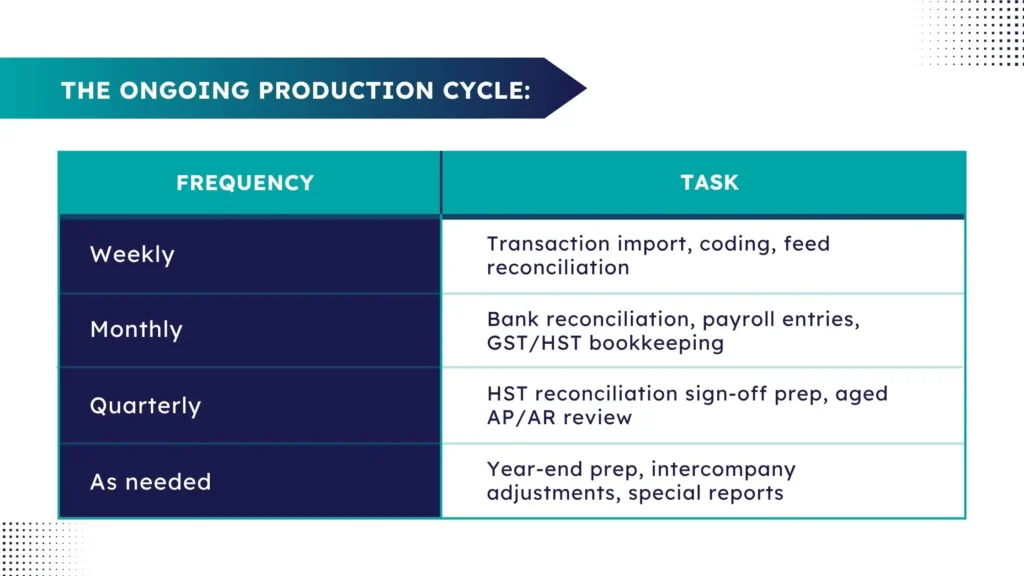
The outsourced team works inside the firm’s existing client files. No data migration. No parallel systems. The workflow runs through a shared task management layer so the in-house team always knows where each file stands.
The Review Gate
Nothing goes to the client without internal review. The outsourced production work lands on the desk of the firm’s reviewer or manager, who checks for errors, flags questions, and approves the period close. This is where firm judgment lives. The outsourced team does not make decisions. It is executed.
Quality Control and Data Security
Security concerns are legitimate. Canadian accounting firms hold sensitive financial data for their clients, and any outsourcing arrangement must address this clearly.
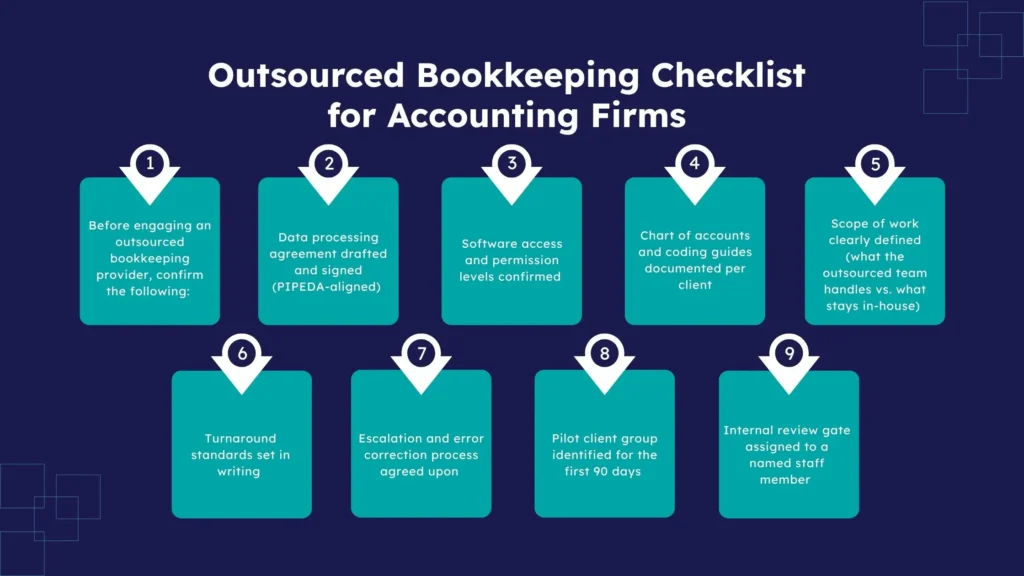
PIPEDA compliance is the baseline. Any outsourced bookkeeping partner handling client data must operate under a formal data processing agreement that aligns with Canada’s Personal Information Protection and Electronic Documents Act. Firms should confirm this in writing before any files transfer.
From a quality standpoint, the model works best when the firm treats the outsourced team as a production extension, not a separate contractor. That means:
- Documented coding guides per client
- Clear escalation paths for ambiguous transactions
- Regular file audits during the first 60 days
- Defined turnaround standards with accountability metrics
CPA Canada’s practice management resources provide useful frameworks for documenting internal controls that apply just as well as to outsourced arrangements as in-house ones.
Warning Signs: When Your Bookkeeping Model Is Holding the Firm Back
Not every firm needs to be outsourced immediately. But these patterns suggest the current model has a ceiling:
- Senior staff regularly work weekends to clear bookkeeping backlogs before review deadlines
- The firm has declined new clients because there is no production capacity to take them on
- Advisory conversations are getting rescheduled because file prep is not complete
- Staff turnover is partly driven by dissatisfaction with high-volume, low-complexity work
- Revenue per staff has plateaued despite reasonable client growth
If three or more of these apply, bookkeeping workflow outsourcing is worth a serious evaluation.
What Firms Do with the Reclaimed Hours
This is the real business case. Accounting firm growth stalls when partners and senior staff cannot get out of production. Outsourced bookkeeping is not just about efficiency. It is about redeployment.
Firms that shift production work to an outsourced model typically redirect that capacity toward:
Higher-margin advisory services. Tax planning, cash flow forecasting, business restructuring, and virtual CFO engagements all carry significantly higher billing rates than compliance work. Freeing 20 hours per month per senior staff member creates room to take on two to three advisory clients per person.
Faster client onboarding. When production capacity is not the constraint, firms can bring on new clients more aggressively. Accounting firm growth that used to require a new hire now happens within existing headcount.
Reduced staff burnout. A Statistics Canada report on workplace stress found that workload volume is consistently among the top drivers of burnout in professional services. Removing repetitive high-volume tasks changes the day-to-day experience for junior and intermediate staff significantly.
Best Practices for Outsourcing Bookkeeping Without Disrupting Client Service
- Start with a pilot file group. Choose 10 to 15 lower-complexity client files for the first 90 days. Refine the workflow before rolling out firm wide.
- Document everything upfront. Coding guides, client preferences, platform logins, and escalation rules should all be captured before work transfers.
- Keep clients in the loop (selectively). Most clients do not need to know who prepares their books, only that their firm reviews and signs off. Be transparent when clients ask directly.
- Review turnaround standards monthly for the first quarter. Quality and timing expectations need calibration in the early months.
- Assign a single internal point of contact. One person on the firm side should own the outsourced relationship day-to-day. Shared ownership creates gaps.
Conclusion
Outsourced bookkeeping is a deliberate operating decision that separates firms content to stay at their current size from those building toward something larger. When production work moves to a reliable external partner, the firm’s core team can do the work they were trained for: thinking, advising, and building client relationships that last.
Canadian firms that have made this shift consistently describe the same outcome. They did not just save time. They changed what their practice is capable of.
How NCSGX Canada Can Help
NCSGX Canada works with Canadian accounting firms as a dedicated outsourced bookkeeping partner. The model is built specifically for firms that want to offload production work without losing control of quality or client relationships.
What that looks like in practice:
- Scalable support that adjusts as your client base grows, with no requirement to hire and train additional in-house staff
- Compliance accuracy across GST/HST, payroll bookkeeping, and CRA-aligned reconciliations
- Reporting visibility through clean, review-ready files delivered on schedule every period
- Cost efficiency compared to the fully loaded cost of an in-house bookkeeper at the same output volume
NCSGX operates inside your existing software environment and workflows. Your clients’ experience stays consistent. Your team gets their time back.
Ready to see what this looks like for your firm? Talk to the NCSGX team and get a clear picture of what outsourcing your bookkeeping production could mean for your capacity, your margins, and your next phase of growth.
Frequently Asked Questions (FAQ)
1. What bookkeeping tasks can a Canadian accounting firm outsource?
Firms can outsource transaction coding, bank and credit card reconciliations, GST/HST and payroll bookkeeping entries, accounts payable and receivable tracking, month-end close preparation, and working paper prep for year-end. The firm retains full review and sign-off authority.
2. Is outsourced bookkeeping secure and PIPEDA compliant?
It can be, provided the outsourced partner operates under a formal data processing agreement aligned with Canada’s Personal Information Protection and Electronic Documents Act (PIPEDA). Firms should confirm this in writing before transferring any client files.
3. Will my clients know their bookkeeping is outsourced?
Most clients do not ask, and there is no obligation to disclose unless your engagement letter requires it or a client asks directly. The firm reviews and signs off on all work, so the client relationship stays with the firm.
4. Does outsourcing bookkeeping affect accuracy or quality?
Not when the arrangement is properly structured. Quality depends on documented coding guides, clear escalation rules, and a disciplined internal review process. Firms that invest in the setup phase consistently report equal or better accuracy compared to in-house production.
5. How do we start outsourcing bookkeeping without disrupting current work?
Start with a pilot group of 10 to 15 lower-complexity client files. Use the first 90 days to calibrate turnaround times, coding preferences, and the review workflow. Expand to the broader client base once the process is stable.